People talk about bucket lists, how you should have one and try to complete it before you pass away. I think it’s always hard to establish one, because as you get older it changes with your interests, hobbies and lifestyles. For me however there is one place I have always wanted to go, the Galapagos. I guess you know it deserves its place on your bucket list when your opinion on visiting hasn’t changed over the last ten years.
My desire to visit stems from my love of organisms, plant or animal, it’s so exciting to see a species that you’ve never seen before. I, like many, grew up watching nature documentaries with David Attenborough, Michaela Strachan and many others inspiring me, I couldn’t get enough! Also visits to natural history museums and learning about naturalists, who adventured into unexplored places to discover new species and document them. It always seemed like the perfect job.
As a biologist who studies marine biodiversity, I also had an interest to walk in the footsteps of Charles Darwin, one of the key naturalists behind the theory of evolution (the other being Alfred Russell Wallace). His expedition to the Galapagos was key in proving his theories, through the realisation of natural selection portrayed in the finches that live there. It is possible to see the unique adaptations in finch beaks that are specific to the environment that each species lives in.
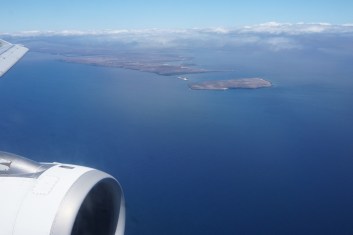
All of these reasons gave Galapagos a prime seat on my bucket list, so as I woke up yesterday morning in Ecuador I had more excitement than a kid on Christmas eve. As we flew into the islands the clouds parted to show the azure ocean and small flat green islands dotted amongst it. The wind hits you hard as you step off the plane, which was pleasantly reminiscent of my home in Bodø Norway, aka the windy city.
It was all action after landing; we headed straight into the highlands of Santa Cruz, the most populated island in the Galapagos. The majority of the island is arid, with cacti and lots of trees that look like they are dying of thirst. In the highlands however there is more precipitation creating lush green forests. Our first stop was at 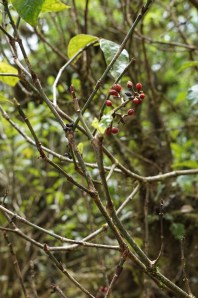 some collapsed craters. They were formed from lava chambers collapsing in and were colossal in size. Along the trail we got to know some endemic and invasive species. Ecuador is famous for producing coffee but in the Galapagos there is only one native plant, the Galapagan coffee plant. However, the beans are too small to be harvested. The common blackberry and guava plant are both introduced species reeking havoc for native species. Conservation programs with the aid of tourist donations are working to reduce their impact on the island.
Next stop on the tour was to see the Galapagos tortoises. Within the Galapagos archipelago there are 15 species of tortoise. The species that we visited has a population of 3000 on Santa Cruz (species name: Chelonoidis porteri ). It is hard to imagine just how big they are before you come face to face with them.  They are a natural curiosity and move surprisingly quickly for their weight, as well as travelling up to 18km per day. The males are much larger than the females and have a longer tail. We watched as they chowed down on guava fruits smearing it all over their faces and took sips from rancid looking green pools. Alongside the tortoises we observed plenty of bird species including: small ground finches, yellow warblers, the common gallinule (a local chicken), black-necked stilts. The finches were friendly chubby little birds they came right up to us with no fear. We watched as they darted back and forth from tree to tree and hopped across the ground.
A few birds of the Galapagos black-necked stilt Himantopus mexicanus (top left); small ground finch Geospiza fortis (top right); (bottom left); female medium ground finch Geospiza fuliginosa (bottom right)
As we arrived at our hotel for the evening, head full of the immense amount of nature that we took in, we were greeted by the locals. Most of which were having an evening siesta, with an iguana occasionally shooting salt from its nose. It’s incredible to be so close to so such a variety of animals and I look forward to the next step of this adventure.

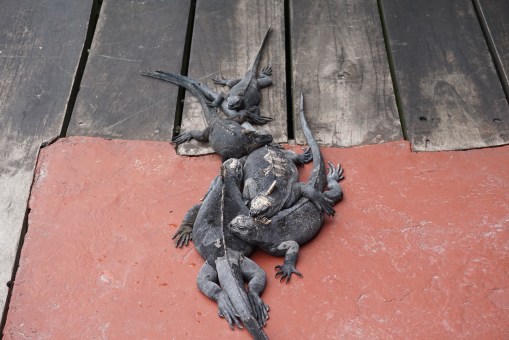
Meet the locals Sealions, Zalophus wollebaeki and marine iguanas Amblyrhyncus cristata






 lissAdventures